Quick Summary
- Fire department accreditation is a data-driven, quality-improvement model, and the credibility of your data determines the strength of your case.
- The Community Risk Assessment and Standard of Cover require precise, traceable response-time and deployment data over multiple years.
- Dispatcher-entered timestamps introduce gaps and errors exactly where accreditation demands accuracy.
- Capturing status and benchmark times at the point of action produces cleaner, more defensible records.
- Automated export and reporting turn those field actions into the auditable documentation reviewers expect.
What Accreditation and Standard of Cover Require of Your Data
Fire department accreditation through the Center for Public Safety Excellence is, in its own words, an all-hazard, quality-improvement model based on risk analysis and self-assessment that establishes community-adopted performance targets, and the model depends heavily on the collection and analysis of data (Esri, citing CPSE). The program is administered by CPSE through its Commission on Fire Accreditation International, or CFAI (CPSE).
At the foundation of the process sit the Community Risk Assessment and the Standard of Cover. Together they define the risks a department faces, document the department's current baseline performance, and set benchmark goals for improvement (CPSE). This is where response data becomes central, because a department can't credibly measure its performance against a risk without accurate records of how it actually performed.
The rigor here's specific. Under the CFAI model, performance data is reported at the 90th percentile and must be maintained and presented during each annual compliance report, with agencies tracking this data for three years when seeking initial accreditation and five years for reaccreditation (CPSE Information Technology Specifications). Data that's inconsistent from year to year, or that can't be traced back to a reliable source, undermines the entire submission.
Why Manual Timestamps Fall Short
The weakest link in most departments' response data is the timestamp. When a unit's en route, arrival, and available times depend on a responder calling them over the radio and a dispatcher keying them in, several failure modes creep in. Radio traffic gets stacked during busy periods, times get estimated after the fact, and multiple simultaneous incidents make it easy to attribute a time to the wrong unit.
None of this reflects poorly on dispatchers, who are doing demanding work under real pressure. It simply means the method itself introduces error. Those small inaccuracies compound across hundreds of incidents into response-time statistics that a chief can't fully stand behind.
This lands directly on the frustrations that many combination-department chiefs already feel about their current systems, including inaccurate data and unreliable response-time analysis. For accreditation, the stakes are higher than day-to-day reporting, because a reviewer is specifically testing whether the numbers are trustworthy. Precision at the moment of capture is the only durable fix.
Capturing Precise Times at the Point of Action
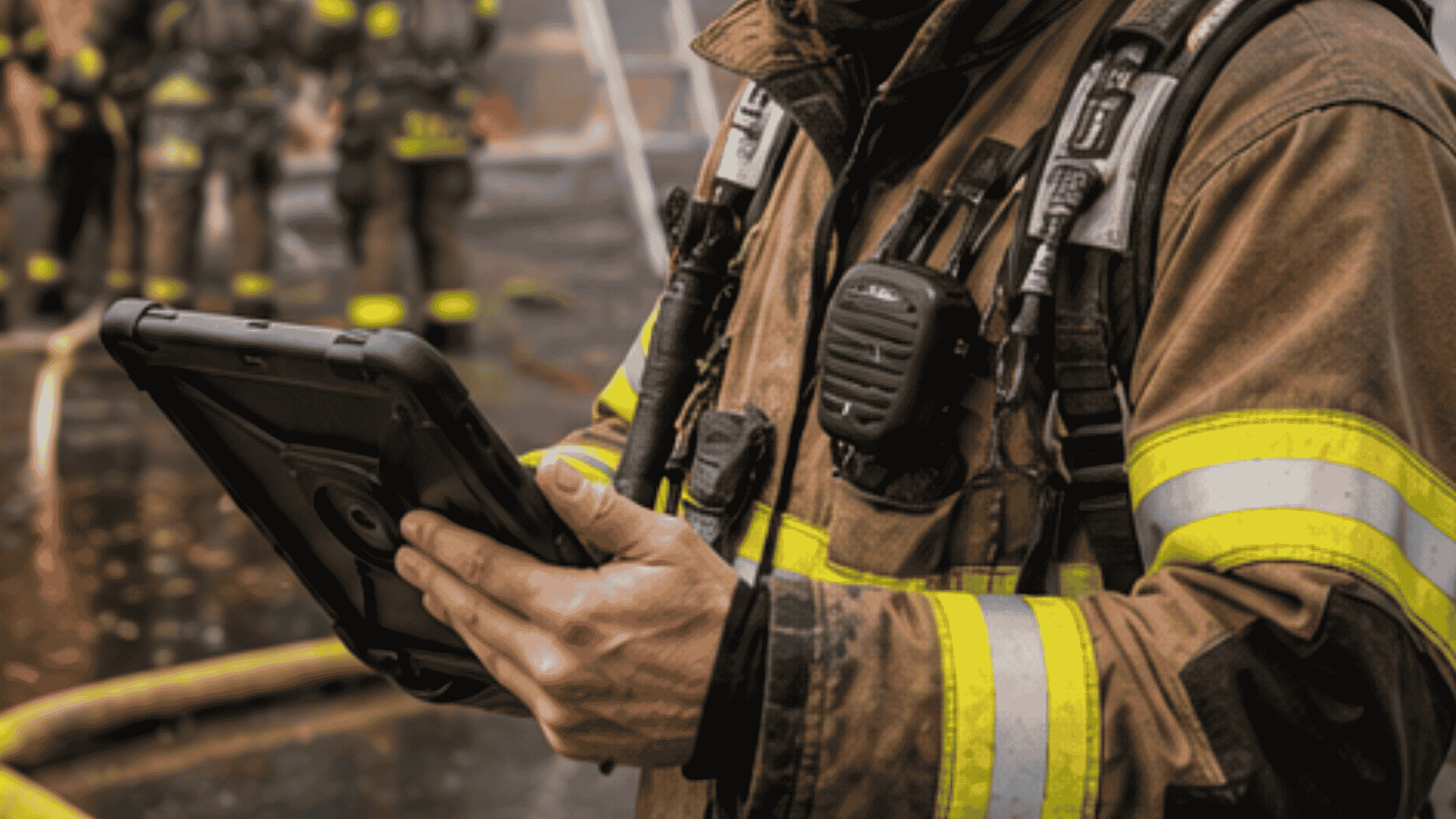
The most reliable timestamp is the one recorded by the person taking the action, at the instant they take it. That's the principle behind status buttons on a response device. Instead of relaying a time and hoping it's transcribed correctly, the responder taps a button and the precise time is recorded automatically.
Unit Status Times, Recorded at the Source
StreetWise captures unit status this way. When a responder changes status such as en route, arrived, or available, the timestamp is recorded instantly on the server for later retrieval, independent of dispatcher workload or radio congestion. The result is a set of unit times that reflect what actually happened, captured with a level of precision that busy dispatchers often can't match.
Benchmarks That Document On-Scene Performance
Accreditation analytics also care about what happens during the incident, not just the response to it. StreetWise benchmark buttons record the key moments a reviewer wants documented, including timestamps like First Water Applied, Patient Contact Made, and PAR Check Conducted. These benchmarks give a department the granular, defensible record of on-scene performance that a Standard of Cover is built to demonstrate.
Turning Field Actions Into an Auditable Record
Capturing precise times is the first step. Making them part of a complete, reviewable record is the second, and it's where the workflow either holds together or breaks down. Data that lives in one system and has to be re-entered into another is data that accumulates new errors.
StreetWise closes that loop through automated export and reporting:
- RMS export. StreetWise sends incident data, including the precise status times and benchmark timestamps, into your records management system automatically, available in XML or JSON. This removes the double data entry that so often introduces mistakes.
- Benchmark recording for analytics. The platform's incident benchmark status recording is designed with accreditation analytics in mind, so the moments you capture are the moments the model asks about.
- Deployment analysis. AVL data supports analysis of where units are and how they're deployed across your response area, which speaks directly to the coverage questions at the heart of a Standard of Cover.
- Reporting portal. A web database portal provides access to canned reports, custom reports, and analytics, giving your administrative team the tools to compile the annual performance documentation the process requires.
Because these capabilities work together, the precise time a firefighter recorded on scene flows into the record without a person retyping it, preserving both the accuracy and the traceability that reviewers look for.
Building the Chain of Custody
Reviewers trust data they can follow from origin to report. That unbroken path, from the moment an action occurs to the figure that appears in a compliance submission, is what gives a Standard of Cover its credibility. Any point where a human manually transfers or estimates a value is a point where trust erodes.
StreetWise supports this chain through its optional bi-directional CAD interface, which keeps data consistent from dispatch through the life of the incident. Status button activations can be made available to a CAD vendor through an optional bi-directional programming interface, so the response system, the CAD, and the records management system stay aligned rather than telling three slightly different stories. When the data chain is intact, a chief can answer a reviewer's questions with confidence rather than caveats.
The Same Precision That Improves Your ISO Rating
The same precision that supports accreditation also supports better ISO ratings, since both reward accurate, well-documented performance. Our related article on how data accuracy drives better department scores explores that connection in more depth, and the StreetWise all-in-one solution page shows how the response, reporting, and integration pieces fit together as one system.
FAQ
What data does CPSE accreditation require for a Standard of Cover?
The Standard of Cover requires documented, community-specific performance data that shows how a department responds to identified risks. Under the CFAI model this data is reported at the 90th percentile and maintained across multiple years, with three years of data for initial accreditation and five years for reaccreditation (CPSE).
Why are dispatcher-entered timestamps a problem for accreditation?
Times relayed over the radio and keyed in by hand are prone to estimation, delay, and misattribution, especially during busy periods or simultaneous incidents. Because accreditation reviewers specifically test whether performance data is reliable, those small inaccuracies can weaken an otherwise strong submission.
Which incident benchmarks matter most for accreditation analytics?
Benchmarks that document on-scene performance are especially valuable, including First Water Applied, Patient Contact Made, and PAR Check Conducted. Capturing these with precise timestamps gives a department the granular record that a Standard of Cover is designed to demonstrate.
How does accurate response data affect an ISO rating?
Accurate, well-documented performance data supports both accreditation and a department's ISO Public Protection Classification, since both reward reliable records and measurable performance. Improving the precision of your response and reporting data can strengthen your position across both efforts at once.
Data You Can Defend
Accreditation is ultimately an exercise in credibility. A department that commits the time to a Community Risk Assessment and a Standard of Cover deserves to have its performance data taken seriously, and that only happens when the data is precise, consistent, and traceable. The difference between a strong submission and a shaky one often comes down to how the numbers were captured in the first place.
Automating timestamp and benchmark capture at the point of action, then carrying that data into your records and reports without manual re-entry, gives your department documentation it can stand behind through initial accreditation and every reaccreditation cycle that follows. To see how StreetWise captures accreditation-grade response data and turns it into reviewer-ready reports, contact the StreetWise team for a demonstration.