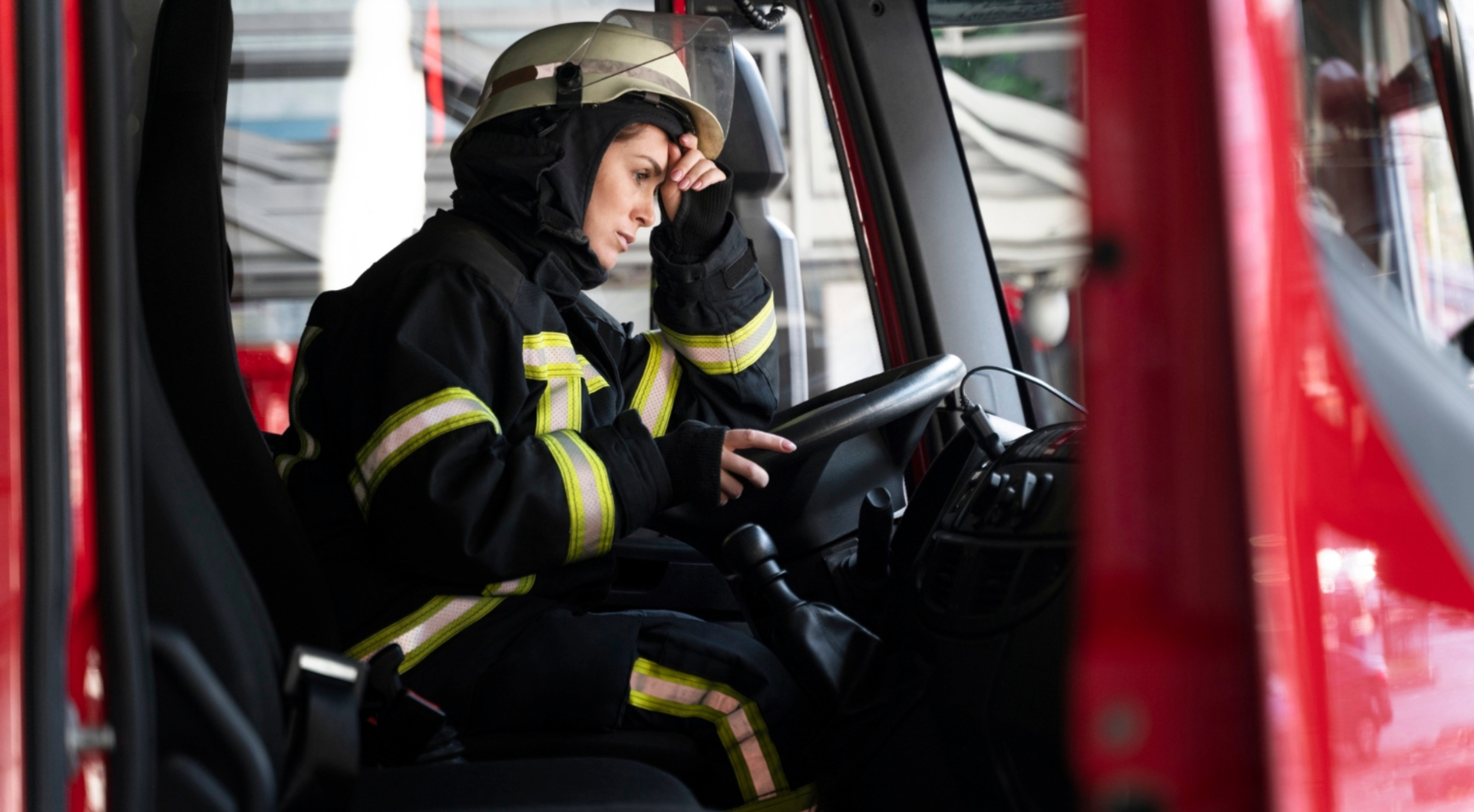
For decades, firefighter safety was measured almost exclusively through after-the-fact reporting. An injury occurred, a form was filled out, and the data sat in a filing cabinet. But a new generation of fire service leaders is shifting that paradigm. Armed with technology that captures precise response data, situational awareness tools, and automated reporting, today's fire chiefs are turning safety from a reactive exercise into a proactive, data-driven discipline.
This article explores the safety key performance indicators (KPIs) that matter most, where traditional tracking methods fall short, and how integrated technology platforms are giving departments the tools they need to protect their people.
Quick Summary
Firefighter injuries remain a persistent challenge — an estimated 53,575 municipal firefighters were injured in the line of duty in 2024 alone. Traditional safety tracking relies on manual timestamps and paper-based reporting that produce incomplete, inaccurate data. Modern technology closes these gaps through:
- One-touch status buttons that capture precise timestamps
- Pre-incident planning tools that improve situational awareness before arrival
- Real-time AVL tracking and tactical waypoints for on-scene coordination
- Automated RMS integration that eliminates manual data re-entry
The result: fire chiefs get the clean, reliable data they need to identify injury patterns and make evidence-based changes that protect their people.
The Safety KPIs Every Fire Chief Should Be Tracking
Safety is not a single metric. It's a constellation of data points that, when tracked consistently, reveal patterns and drive better decisions. The most effective fire departments are monitoring several interconnected KPIs that directly influence injury prevention.
Response time accuracy is the foundation. When departments don't have precise data on how long it takes units to arrive, they can't identify whether crews are being placed in avoidable risk situations. Rushed responses caused by inaccurate dispatch information or poor routing can increase the likelihood of apparatus accidents and on-scene injuries.
Turnout time, also known as chute time, measures the interval between when a station is alerted and when the apparatus is rolling. According to NFPA standards, this window should be tightly controlled. Tracking it with precision helps identify whether crews are departing safely or scrambling in ways that lead to slips, falls, and strains.
Scene arrival preparedness is another critical metric. Did the responding crew have access to preplan data before they arrived? Were hazard conditions, hydrant locations, and building layouts available en route? Departments that can answer "yes" consistently tend to see fewer on-scene injuries because crews are making informed decisions rather than improvising.
Incident benchmark documentation adds another layer of safety visibility. Recording the precise timestamps for events like First Water Applied, Patient Contact Made, and PAR Check Conducted creates an auditable timeline that helps leadership identify where operations are running smoothly and where dangerous gaps exist.
At a high level, the KPIs that most directly support a safety-focused culture include:
- Response time accuracy — dispatch to on-scene, broken down by unit
- Turnout/chute time with countdown tracking
- Scene arrival preparedness — preplan access rate per call
- Incident benchmark timestamps — First Water, Patient Contact, PAR checks
- Near-miss and injury trend analysis over time
- Apparatus accident rates during response and return
Where Traditional Safety Tracking Falls Short
If accurate data is the lifeblood of safety improvement, then many departments are operating with a dangerously weak pulse. Traditional safety tracking methods are riddled with gaps that obscure the very patterns chiefs need to see.
Inaccurate timestamps are one of the most common problems. In many departments, dispatchers are responsible for logging when units go en route, arrive on scene, and return to service. But dispatchers are managing multiple channels, handling incoming calls, and coordinating resources simultaneously. Even conscientious dispatchers can be off by minutes when manually logging unit status changes — and those minutes matter enormously when you're trying to analyze response performance and identify safety trends.
Radio-based status updates compound the issue. When multiple units are trying to report status changes over congested radio channels, updates are frequently delayed, missed, or recorded out of sequence. The result is a data set that looks complete on paper but tells a distorted story about what actually happened on the call.
Paper-based or delayed after-action reporting introduces yet another layer of inaccuracy. When crews document incidents hours or even days after the fact, critical details are lost. The specifics of how an injury occurred, what conditions were present, and what tactical decisions preceded it become faded memories rather than precise records.
Perhaps most concerning is the inability to correlate scene-level data with injury outcomes when records are incomplete. If a department can't reliably identify that injuries spike during certain call types, at certain times of day, or in certain response zones, it cannot take targeted preventive action.
Here's a summary of where traditional methods consistently break down:
- Dispatcher-entered timestamps are often minutes off due to multitasking demands
- Congested radio channels cause missed, delayed, or out-of-sequence status updates
- After-the-fact reporting loses critical incident details to faded memory
- Disconnected systems prevent correlation between scene data and injury outcomes
- Incomplete records create blind spots that mask patterns in injury trends
How Technology Is Changing the Safety Equation
The good news is that the technology to close these data gaps already exists — and it doesn't require a massive budget to implement. Departments that integrate modern response technology into their operations are seeing measurable improvements in the accuracy and completeness of their safety data, which in turn enables smarter, more targeted injury prevention efforts.
Precise Timestamp Documentation
The single most impactful improvement a department can make for safety tracking is eliminating manual timestamp entry. When crew members can tap a status button on their apparatus tablet or smartphone to record En Route, Arrived, Available, and other status changes, the timestamp is captured at the exact moment it occurs and recorded directly to the server.
This approach removes dispatchers from the equation entirely for status tracking purposes, freeing them to focus on their primary responsibilities while simultaneously producing far more accurate data. Unit status timestamps are instantly recorded in the server for later retrieval, enhancing documentation of truly accurate response times StreetWise Features.
Beyond basic status tracking, incident benchmark buttons allow incident commanders to record precise timestamps for critical safety events. When a commander taps "First Water Applied," "Patient Contact Made," or "PAR Check Conducted," that information and the exact time are captured automatically. These benchmarks create a detailed operational timeline that is invaluable for post-incident safety analysis.
Key capabilities that improve timestamp accuracy include:
- One-touch status buttons that record En Route, Arrived, and Available at the exact moment they occur
- Incident benchmark buttons for First Water Applied, Patient Contact Made, PAR Check Conducted, and other critical events
- Automatic RMS export in XML or JSON format, eliminating manual re-entry
- Bi-directional CAD interfaces that make status button activations instantly available to dispatch
Situational Awareness Before Arrival
A significant portion of firefighter injuries occur not from fire exposure, but from decisions made with incomplete information. When crews arrive at a scene without knowing the building layout, hazard conditions, or water supply locations, they are forced to improvise under pressure — and improvisation in emergency conditions is where injuries happen.
NFPA data consistently shows that roughly 30 percent of all firefighter injuries occur on the fireground (NFPA, United States Firefighter Injuries in 2024), and the leading cause is overexertion and strain. While not every strain is preventable, many are exacerbated by situations where crews lack critical information that would have changed their approach.
Technology platforms that deliver pre-incident planning data directly to apparatus tablets give crews a significant safety advantage. The information available en route includes:
- Occupancy preplans with building data, construction type, special hazards, and embedded photos
- Hydrant data displayed on tactical maps with flow capacity, main size, and out-of-service indicators
- FDC locations and water supply access points
- Community hazard waypoints visible to all responding units
- Offline access to cached preplan data in areas with poor cell coverage
When every crew member has access to the same hazard information before they step off the rig, coordination improves and the risk of someone walking into an unknown danger decreases significantly.
Real-Time Coordination on Scene
Coordination breakdowns on the fireground are a well-documented contributor to firefighter injuries and fatalities. When units can't track each other's positions, when the incident commander lacks a clear picture of resource deployment, or when tactical assignments are communicated only over congested radio channels, the risk of disorganized operations increases dramatically.
Technology addresses these coordination gaps through several integrated capabilities:
- Live AVL tracking displays all responding units on a shared tactical map with directional apparatus icons
- NIMS-oriented tactical waypoints sync instantly across all devices for staging areas, command posts, and hazard zone warnings
- Instant geo-referenced photo sharing lets units send real-time imagery to the incident commander or other units without leaving the app
- Tap-to-view unit details show staffing levels, pump capacity, EMS level, speed, and heading for any apparatus on the map
For departments looking to enhance incident coordination, solutions like StreetWise CADlink provide these capabilities in an integrated, easy-to-use platform. This eliminates the need to relay complex spatial information over the radio, reducing miscommunication and the dangerous delays that come with it.
Station Alerting and Turnout Safety
The first moments after a dispatch are among the most injury-prone in any emergency response. Firefighters are transitioning from rest or routine activities to high-urgency movement, and the risk of slips, falls, and strains is elevated.
Station alerting systems that provide comprehensive information the moment tones drop help reduce the chaos of initial dispatch:
- Audible and visual alerts with immediate incident details
- Route maps from station to scene with surrounding hydrant locations
- Live responder status showing who is coming and where they are
- Chute timer countdowns that promote safe, measured departures rather than panicked rushes
Rather than scrambling to gather information while donning gear, crews receive a complete operational picture instantly — setting the stage for a safer, more controlled departure.
Turning Safety Data Into Actionable Change
Collecting accurate safety data is only valuable if it drives action. The most forward-thinking departments are using their technology-generated data to identify injury patterns and implement targeted interventions.
When a department has accurate, device-captured response time data, it can analyze whether injuries are clustering around specific variables:
- Are apparatus accidents more common on certain routes?
- Do injuries spike during particular call types or incident complexities?
- Are there times of day when turnout-related strains increase?
- Do specific response zones show higher injury rates than others?
- Are PAR check intervals stretching beyond safe thresholds?
Without precise data, these questions are unanswerable. With it, they become the foundation for evidence-based policy changes.
The transition to NERIS, the National Emergency Response Information System that is replacing the legacy NFIRS reporting platform, is amplifying the importance of data quality. NERIS places greater emphasis on granular, accurate response data and provides near-real-time analytical tools that departments can use for resource allocation and risk assessment (USFA NERIS Overview). Departments that are already capturing clean, automated data are positioned to leverage these new analytical capabilities immediately.
Hypothetical Example: A fire chief reviews six months of device-captured response data and notices that strains and sprains are disproportionately concentrated in calls originating from a specific dispatch zone. Digging deeper, the chief finds that the zone's primary response route involves a sharp downhill grade that causes apparatus to brake hard at a problematic intersection. Armed with this data, the department adjusts the default route for that zone and institutes a training reminder about safe apparatus handling on grades. Over the next quarter, zone-specific injuries drop measurably.
The Budget Case for Safety Technology
For smaller departments and volunteer organizations operating on annual technology budgets of $3,000 to $10,000, every dollar must be justified. The good news is that safety technology doesn't have to be expensive to be effective — and the cost of not investing in it can be far greater.
The financial impact of preventable injuries adds up quickly:
- Workers' compensation claims for line-of-duty injuries
- Lost duty time and overtime costs for coverage
- Recruitment and retention impacts when safety culture suffers
- Community trust erosion following preventable incidents
- ISO rating consequences from incomplete or inaccurate data
A single serious line-of-duty injury can cost a department tens of thousands of dollars in direct expenses alone, not counting the incalculable impact on morale.
Accurate data also supports better ISO ratings, which directly impact insurance costs for the communities departments serve. When a department can demonstrate precise response time documentation, effective resource deployment, and comprehensive incident reporting, it strengthens its position in ISO evaluations. For a deeper look at how data accuracy drives ISO improvements, see ISO Rating Improvements: How Data Accuracy Drives Better Department Scores.
Technology solutions that integrate response notification, status tracking, preplan management, and RMS reporting into a single platform deliver outsized value for budget-conscious departments. Rather than purchasing separate tools for each function, an integrated approach reduces cost, complexity, and the risk of data falling through the cracks between disconnected systems.
Frequently Asked Questions
What are the most important safety metrics for a fire department to track?
The most impactful safety KPIs include response time accuracy (from dispatch to on-scene arrival by unit), turnout/chute time, scene arrival preparedness rates, incident benchmark timestamps for events like First Water Applied and PAR Checks, near-miss and injury trend data over time, and apparatus accident rates during response and return. Tracking these metrics consistently allows leadership to identify patterns and implement targeted interventions before injuries occur.
How does technology reduce firefighter line-of-duty injuries?
Technology reduces injuries through three primary mechanisms. First, it improves situational awareness by delivering preplan data, hydrant locations, and hazard information to crews before they arrive on scene. Second, it enables real-time coordination through live unit tracking, tactical waypoints, and instant photo sharing. Third, it generates accurate data that helps leadership identify injury patterns and make evidence-based changes to policies, routes, training, and resource deployment.
Can small or volunteer departments afford safety technology?
Yes. Many integrated platforms are designed specifically for departments with limited budgets. Solutions that combine response notification, status tracking, preplan management, and RMS reporting into a single subscription reduce cost and complexity compared to purchasing separate tools. Additionally, the savings from reduced workers' compensation claims, fewer lost duty days, and improved ISO ratings often offset the technology investment within the first year or two. Grants like the Assistance to Firefighters Grant (AFG) program can also help fund technology purchases.
How do accurate timestamps improve firefighter safety?
Accurate timestamps create a reliable record of response operations that can be analyzed for safety patterns. When departments know exactly when units went en route, arrived on scene, applied water, made patient contact, and conducted PAR checks, they can identify operational bottlenecks, measure compliance with safety protocols, and spot concerning trends. For example, consistently slow PAR check times might indicate a need for additional accountability training, while response time anomalies on certain routes might reveal infrastructure hazards that can be addressed proactively.
Conclusion
Firefighter safety has always been a core value of the fire service. What's changing is the ability to measure it, analyze it, and act on it with precision. Technology doesn't replace the training, experience, and instincts that keep firefighters safe. Instead, it gives department leadership the visibility they need to make smarter decisions — from adjusting response routes and updating training priorities to identifying equipment needs and strengthening incident command protocols.
The 53,575 firefighter injuries reported in 2024 are not just statistics. They represent real people, real families, and real departments that bear the physical, emotional, and financial costs of each incident. Every injury that can be prevented through better data, better situational awareness, and better coordination is worth the investment.
If your department is ready to explore how integrated technology can support a safer operation, contact the StreetWise team to schedule a free demonstration and see how precise data capture, real-time coordination tools, and automated RMS integration work together to protect the people who protect your community.